
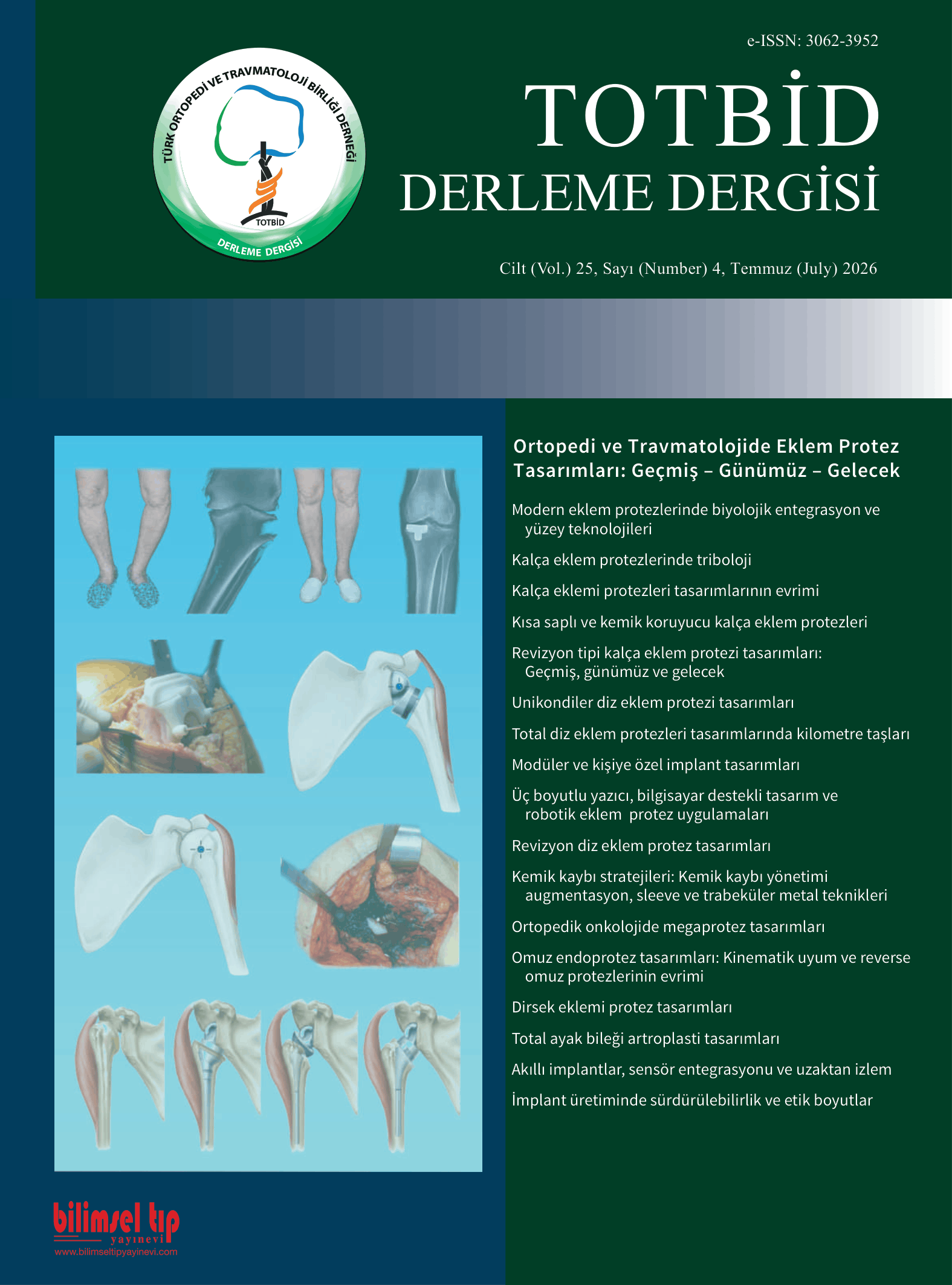
The shoulder joint depends on a delicate biomechanical balance characterized by a wide range of motion, low intrinsic stability, and coordinated force coupling between the rotator cuff and the deltoid. In rotator cuff insufficiency, superior migration of the humeral head, reduced deltoid efficiency, pseudoparalysis, and cuff tear arthropathy develop, thereby exposing the biomechanical limitations of anatomic shoulder arthroplasty. Reverse total shoulder arthroplasty created a new mechanical construct by medializing and inferiorizing the center of rotation and distalizing the humerus, which increased the deltoid moment arm and fundamentally changed treatment in this patient population. Within this developmental process, early failed reverse designs, the Grammont concept, and contemporary implant systems have represented successive design stages that redefined the balance among stability, range of motion, deltoid tension, rotational function, and implant longevity. Modern modifications in glenoid and humeral components have become crucial for reducing scapular notching, improving residual rotation, enhancing fixation quality, and limiting complications. With the expansion of indications, patient selection, careful evaluation of contraindications, and three-dimensional preoperative planning have also become essential determinants of success. Contemporary reverse shoulder arthroplasty should therefore be regarded not as a uniform implant concept, but as a modular reconstructive platform tailored to patient-specific biomechanical demands.